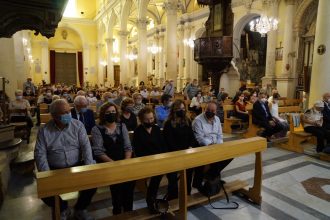
Church of St Paul the Apostle and the Teleri
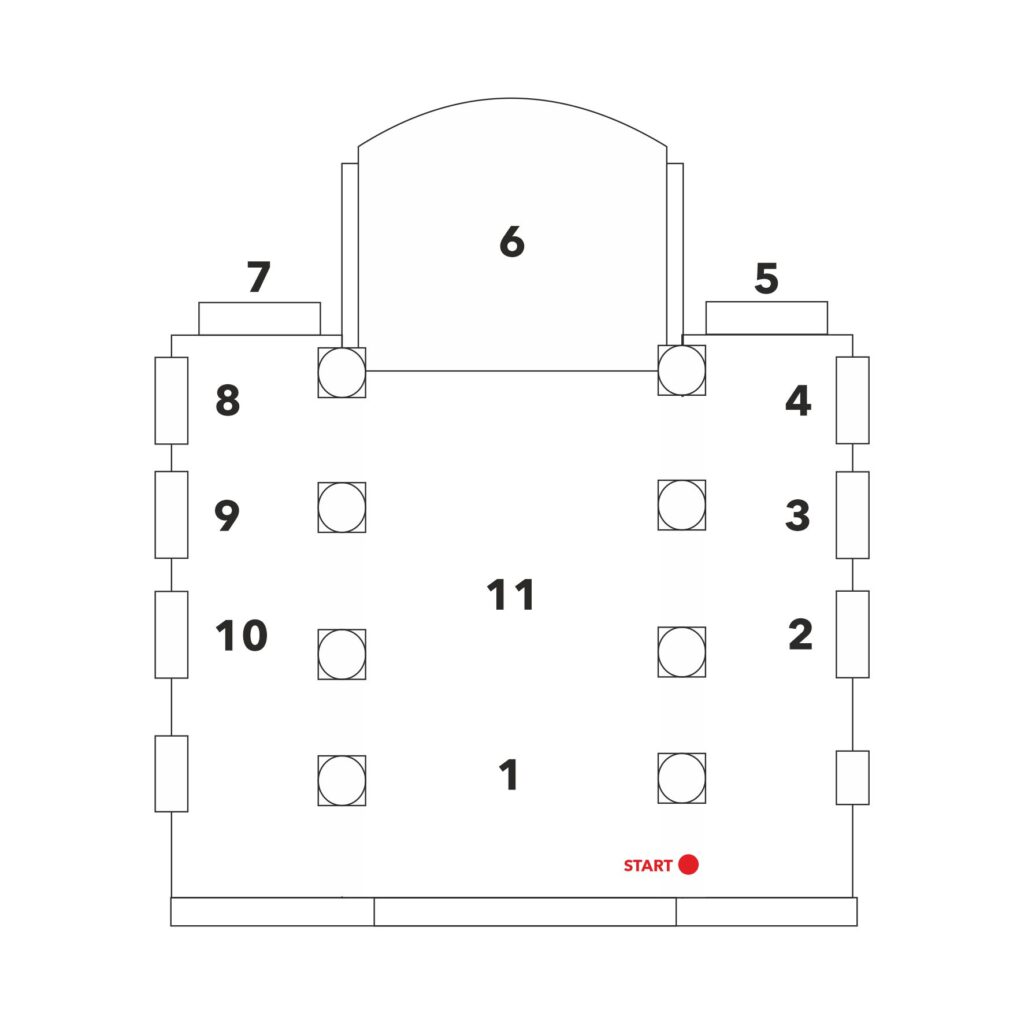
Click on a paragraph to read the guide.
1. History of the Church of St Paul the Apostle
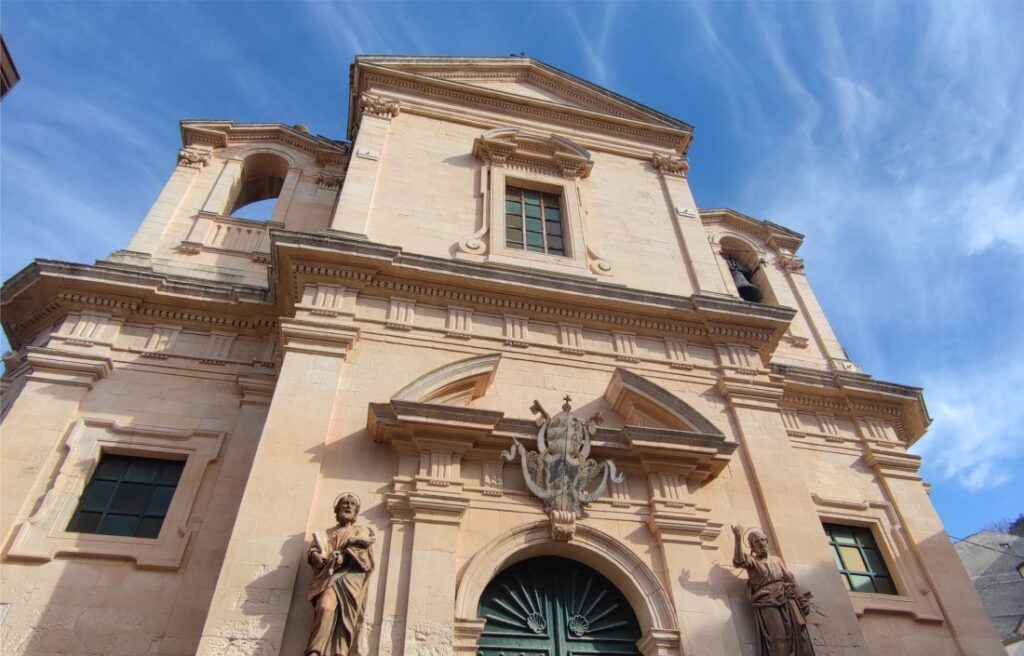
According to the historian Belgiorno, there are records of an earlier building dedicated to St Paul as early as 1400, but the church was seriously damaged by an earthquake in 1631. Perhaps due to the need to undertake essential restoration work, on 9 August 1632 it became a branch church of the mother church of St Peter. It was completely destroyed by the most powerful earthquake of 11 January 1693. Consequently, the building we are visiting is in the late Baroque style, with work continuing until 1903. The façade is flanked by two bell towers, only one of which contains a bell. The building stands atop a flight of steps preceded by a wrought-iron grille, which leads us to the main entrance. This is situated in the first of the two sections into which the façade can be divided. The portal consists of a round arch with a Tuscan capital. On either side of the portal, on two pedestals, stand sculptures of Saint Peter on the left – recognisable by his keys – and Saint Paul on the right – recognisable by his sword – which are copies of the wooden sculptures located in the apse of the Church of Saint Peter. To the sides, corresponding to the side aisles, there are two square windows; in the centre, above a large window overlooking the entrance portal, the date 1903 is inscribed, the year in which work on the façade is believed to have been completed.
The interior of the church is divided into three naves separated by columns of local limestone with ornate Corinthian capitals, materials probably salvaged from the old church. During the lengthy and complex restoration work carried out around 1980 to reinforce the structure with steel tie rods, an inscription dated 1719 was discovered at the base of the first column in the left-hand row, bearing the letters ‘E/LLIPO’ preceded by a ‘V’. The columns support arches crowned by various keystones, depicting the faces of angels. The roof is a cross-vaulted structure in the side aisles and a barrel vault in the central nave.
The Church of St Paul became an independent parish in 1924, subsequently taking over the management of the Church of the Carmine, which had been abandoned by the Carmelite Order following the unification of Italy due to the confiscation of ecclesiastical property and the conversion of the convent into a Carabinieri station. During the 1970s, the parish priest, Cavallo, moved all activities to the adjacent Church of the Carmine, which had by then been restored; consequently, no liturgical celebrations were held in the Church of St Paul – which had never been deconsecrated – for a period of thirty years. In the central nave of the Church of San Paolo, significant unevenness had developed due to structural instability in the columns. Soil was removed from the central nave, and the columns were reinforced with steel cages and stabilised; no tombs or burials were found in the excavated soil. At the start of this millennium, the altars in the side aisles were carefully restored.
The Teleri Paintings of the Passion in Modica
A chance discovery in January 2021 within some rooms used for storage in the former Carmine Convent in Modica led to the recovery of an extraordinary piece of historical and artistic heritage that had been forgotten for almost a century: a cycle of Lenten tapestries of exceptional value to the entire community. The Lenten tapestries are large pieces made of hemp and linen depicting scenes from the Passion of Jesus; they were designed to be used exclusively during the liturgical season of Lent to cover the altars, statues and paintings that adorned the church during the rest of the year. In this way, the entire sacred building was temporarily transformed into a visually and chromatically unified space, akin to an oratory, where the spiritual attention of the faithful was focused solely on the narrative of the Passion. This striking and visually powerful theatrical device ensured a central role for Carmelite catechesis, drawing large crowds captivated by the simultaneous lowering of all the drapes, probably accompanied by the roll of drums.
To carry out such a demanding undertaking, the Convent had obtained all necessary civil and religious authorisations in advance, identifying patrons amongst the friars from wealthy families and the noble houses close to the Order. The initiative, however, led to fierce clashes with the Franciscan Order, which, holding a virtual monopoly on Easter preaching, attempted to convince the people that the use of such displays did not guarantee an indulgence. Designed to complement the architecture of the Carmine, completed around 1760, the ‘ ’ canvases are of monumental dimensions: the main ‘Taledda’ of the high altar stands over eight metres tall, whilst the smaller canvases intended for the side altars measure almost five metres. Although seven have been discovered to date, an inventory from 1804 attests that the cycle originally comprised nine. Thanks to the inscriptions on the works, we know that they were created in 1795 and commissioned by figures such as the reverends Giuseppe Maria Ruta, Angelo Maria Ruta, Celestino Celestre and the family of the friar Carmelo Maria Ferraro. The artist remains formally unknown, but the style and concise technique — with black outlines and shades of blue and white on the unprimed canvas — suggest the hand of the local painter Giovanni Battista Ragazzi or artists from his circle.
All memory of the existence and use of these canvases had been completely lost, as the custom was discontinued around a century ago when the Church embarked on a gradual simplification of the liturgy aimed at eliminating Baroque elements deemed excessively theatrical, as evidenced by the official ban imposed by the neighbouring Diocese of Syracuse in 1922. At the time of their rediscovery, the works were in a poor state of preservation, but following initial stabilisation and cleaning work, the restoration of six smaller canvases was completed in 2025, whilst work on the large altarpiece is still pending. The originality of the Modica cycle lies in its overall conception: rather than confining the depiction solely to the chancel with a Crucifixion or Deposition, the work unfolds as a genuine sequential narrative of the stories of the Passion. The centrepiece is the altarpiece of the high altar, which features an unprecedented subject linked to the Carmelite identity: the upper register depicts the Our Lady of Mount Carmel with apostles and angels, whilst the lower register shows the Sacrifice of Isaac as a foreshadowing of Christ, presenting a two-register structure entirely analogous to the famous Easter panel painted in 1791 by Giuseppe Russo for the church of San Giacomo in Milazzo.
Whilst the Taledda introduces the Old Testament foreshadowing, the other canvases narrate the key moments of Holy Week with extraordinary stylistic skill and chromatic simplicity. In the Entry into Jerusalem, the artist skilfully manipulates the planes of perspective, making the illuminated figure of Jesus stand out against the bluish background of the city gate; in the Crowning with Thorns, he introduces an iconographic enigma by placing a female figure in military garb with a lion’s-skin headdress amongst the soldiers – a Baroque allegory of human brutality set against the solemn dignity of Christ; finally, in the *Deposition*, the composition is structured around a rigorous pyramidal arrangement of mourners, where the whiteness of the shroud becomes a powerful source of light foreshadowing the Resurrection. This valuable discovery thus significantly enriches the heritage and catalogue of Carmelite Lenten altarpieces in Sicily.
2. Christ’s Entry into Jerusalem
This painting depicts Christ’s Entry into Jerusalem, executed on the characteristic canvas of hemp and flax using the well-established two-tone technique, dominated by bluish, white and grey hues that blend with the ochre background of the raw fabric. At the centre of the complex composition, Jesus is depicted in profile, enveloped and illuminated by a radiant halo, as he rides a donkey towards the city. On the left, the imposing stone arch of Jerusalem’s gateway, rendered in dark, cool tones, serves as a masterful chromatic counterpoint to highlight the facial features and dignity of his face. The artist skilfully orchestrates multiple planes of perspective to accommodate a varied and dynamic crowd: in the foreground, several figures prostrate themselves and spread their cloaks on the ground, including a kneeling mother with an infant on her right and a young girl crouching on her left, whilst in the middle ground the faithful crowd together, waving palm branches and other plant matter. In the background, alongside the city walls, stands a house with an external staircase on which other onlookers are depicted, intrigued and surprised by Jesus’ arrival. From a Gospel perspective, the scene depicts the event of Palm Sunday, which marks the solemn beginning of Holy Week with Christ’s triumphal entry into Jerusalem. Riding a gentle donkey rather than a warhorse, Jesus reveals himself not as an earthly ruler or a conqueror, but as the peaceful king foretold by the ancient biblical prophecies. The warm and festive welcome from the crowd, who acclaim him by waving palm branches and spreading their cloaks in his path, represents the final moment of earthly joy before the tragedy of betrayal and condemnation. For the faithful, this image offers a profound meditation on Christ’s humble kingship and on the transience of human glories, reminding us how those same jubilant cries of ‘Hosanna’ will, within a few days, turn into the cries of the crucifixion, revealing the true meaning of his journey towards the sacrifice of the cross.
3. The Flagellation
This canvas depicts the scene of the Flagellation of Christ, painted using the now familiar two-colour technique that employs shades of blue, white and grey with thick, pronounced black outlines against the ochre background of the raw canvas. At the centre of the composition stands Jesus, bound to a low column and surrounded by a luminous halo, his expression one of resigned and solemn dignity; at his sides, two executioners, captured in dynamic, sculptural poses, vigorously raise their whips to strike him, whilst on the left a Roman soldier in armour observes the scene thoughtfully, flanked in the background by other onlookers and imposing monumental pillars. In the upper part, above a dense mass of dark clouds, three winged angels lean forward in sorrow to witness the torment, whilst in the lower part of the canvas there are some small patches of faded paint that reveal the geometric tiles of the wall behind, near the traces of the original inscription bearing the name of the commissioning Ferraro family. From an evangelical and theological perspective, the depiction evokes the terrible ordeal of the flogging ordered by Pontius Pilate in the praetorium, a crucial moment in the Passion in which the Redeemer’s body is brutally violated prior to his death sentence. This scene combines the extreme realism of physical torture with the divine dimension symbolised by the angels, who, with their compassionate gazes, bear witness to heaven’s participation in the drama of the Innocent One. For the contemplative believer, the flagellation thus becomes an intimate invitation to reflect on the mystery of vicarious suffering, in which Christ freely takes upon himself the sins of humanity, transforming his wounded flesh into an instrument of purification and spiritual salvation.
4. The Crowning with Thorns
This panel depicts the Crowning with Thorns, painted on the characteristic rough Lenten canvas using the established two-tone technique dominated by bluish, white and grey shades, with marked black outlines defining the forms. At the centre of the composition sits Jesus, suffering yet dignified, surrounded and mocked by his tormentors. On the left stands out a unique and previously unseen figure with feminine features, dressed as a soldier, characterised by a thick mane of hair reminiscent of a lion’s mane, captured in the act of pressing the crown of thorns onto Christ’s head. Beside her, a soldier raises a lit torch, revealing smoke and flickering flames, whilst another executioner behind Jesus and one kneeling on the right mock him by offering him a reed as a sceptre. On the right, another soldier armed with a spear watches the scene alongside a bystander leaning against a balustrade. In the background stands a majestic architectural composition set across several levels in depth, featuring columns, a balustrade and a partially open drapery, whilst in the lower left-hand corner is an inscription bearing the name of the patron, Celestino Celestre, and the date 1795.
From a Gospel perspective, the work depicts the moment when the Roman soldiers, inside the praetorium, subject Jesus to a cruel and humiliating mockery of his kingship before leading him to his crucifixion. The purple cloak, the reed sceptre and the crown of thorns are the symbols of this violent mockery, which combines physical pain with extreme psychological humiliation. Theologically, the unprecedented and unsettling female figure who crowns Christ represents an allegorical personification of cruelty and of human bestiality — evoked by the lion’s mane — which lashes out against divine innocence. The solemn serenity preserved on Jesus’ face, set against the blind violence of the soldiers, invites the faithful to contemplate the true kingship of Christ, which is manifested not in earthly power or the force of arms, but in the silence of sacrificial love and in the total acceptance of the Father’s plan of salvation.
5. The Mater Dolorosa. Marian Way of Modica
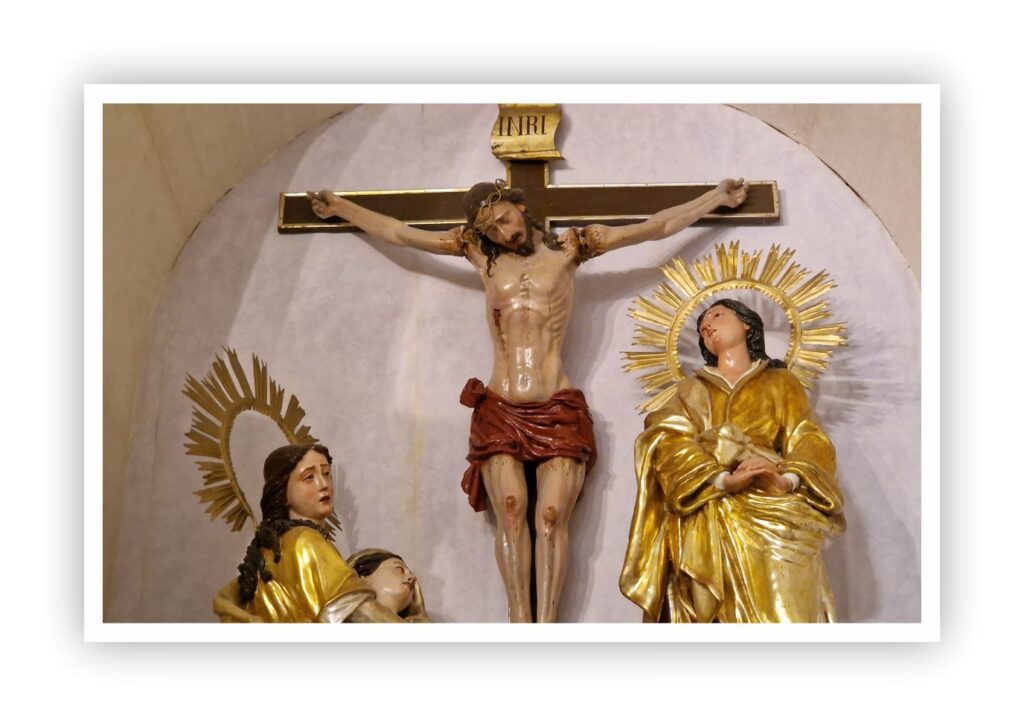
At the fourth altar stands an 18th-century wooden sculptural group, created in several stages, depicting the scene of Our Lady of Sorrows, overcome with grief at the sight of the crucified Christ; the figure of the crucified Christ was probably added in the mid-19th century. Our Lady is supported by a devout woman. The dramatic scene is witnessed by the evangelist John, as he himself recounts in his Gospel:
Jesus, then, seeing his mother and the disciple whom he loved standing beside her, said to his mother, ‘Woman, here is your son!’ Then he said to the disciple, ‘Here is your mother.’ And from that moment the disciple took her into his home.
John 19:26–27
It is Jesus himself who links the figure of Our Lady of Sorrows at the foot of the cross to that of the evangelist John. Thus, devotion to Our Lady of Sorrows, which developed in the Catholic world from the end of the 11th century onwards, has always been linked to the presence of St John the Evangelist. It was Pope Pius VII who, in 1814, introduced it into the Roman liturgical calendar, setting the feast day for 15 September.
Prayer to Our Lady of Sorrows:
Our Lady of Sorrows, you who experienced the profound grief of seeing your Son crucified, we pray that you may be close to us in our sufferings. You know the weight of sorrow and the toil of carrying the cross. Help us to find comfort and hope in your loving arms.
O Mary, Mother of Sorrows, you who shared in Jesus’ path of suffering, intercede for us with your Son.
Help us to find meaning in our pain and to offer it up in union with the Passion of Christ. Grant us the strength to accept God’s will and to persevere in the faith. Our Lady of Sorrows, we pray that you will accompany us along our journey through life.
Be our guide and comforter in times of sadness and sorrow. Help us to understand the redemptive meaning of suffering and to find peace in your motherly love.
Amen
6. Apse and High Altar
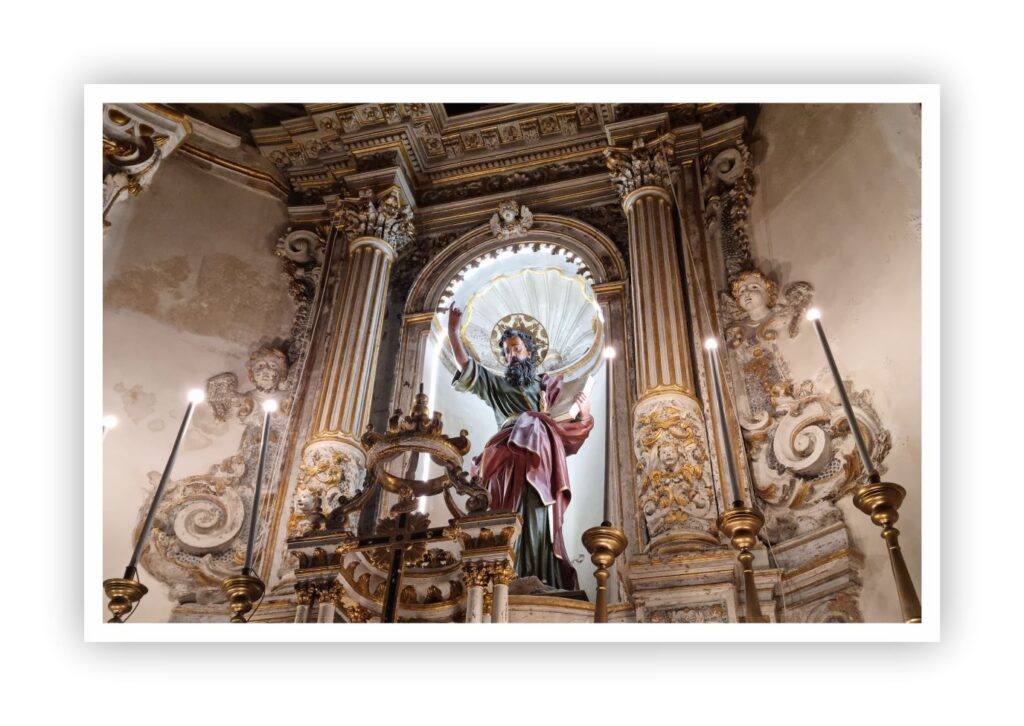
The central altar features an 18th-century work depicting Saint Paul, inspired by the same subject that has been present in the apse of his mother church since the 18th century. As is well known, Saint Paul was originally known as Saul of Tarsus, a fervent Jewish Pharisee. He persecuted Christians until, according to Christian tradition, he had a vision of Jesus on the road to Damascus. Following this experience, Saul, having converted, changed his name to Paul and became one of the greatest missionaries of early Christianity. He travelled throughout the Mediterranean, spreading the Gospel and establishing numerous Christian communities. His letters, contained in the New Testament, form a fundamental part of Christian theology. He was eventually imprisoned and beheaded in Rome, becoming one of the most celebrated martyrs of the Christian Church.
The statue of the saint is depicted with his right arm outstretched and his left hand holding a book with a yellow cover. His face is characterised by a long black beard that blends seamlessly into his hair. His serious gaze is directed towards the observer, then downwards. The saint wears a green robe with gold trim at the edges, but this is interrupted by a red cloak resting on his left shoulder, which wraps around his waist and falls freely towards his feet.
At the foot of the central altar, of particular note is the nineteenth-century marble altar frontal by an anonymous artist, depicting Saint Paul preaching in the Areopagus of Corinth
7. Altar of the Sacred Heart
A statue by an anonymous artist, created at the beginning of the last century. For Christians, the adoration of the Sacred Heart of Jesus has a dual significance: on the one hand, it involves adoring the heart of Jesus as a symbol of his humanity, of his becoming man and sacrificing himself for us all; on the other, it is recognised as the symbol of Jesus’ love for mankind and of his Passion on their behalf. Traditional iconography draws on the symbols of the Passion and depicts the Sacred Heart in the centre of Jesus’ chest, with a cross placed above it, crowned with thorns. On the side of the Heart there is a bleeding wound reminiscent of that inflicted on Jesus on the cross, symbolising the wounds that the sins of mankind continue to inflict upon him every day. The Sacred Heart is surrounded by flames, a symbol of burning mercy and the Saviour’s ardent love for all mankind.
8. The Descent of Jesus from the Cross
Within the arched shape of the canvas is a crowded composition featuring nine figures: at the top, three men balance on ladders in a laborious attempt to lower the pale, lifeless body of Jesus, whilst at the bottom a kneeling figure unfurls a large, white shroud, flanked on the right by a group of pious women in mourning – amongst whom the Virgin with her halo stands out – and on the left by a large metal basin resting on the ground; the entire work is photographed here displayed against a wall decorated with dense geometric majolica tiles in shades of green and blue. From a Gospel perspective, the scene depicts the solemn and sorrowful moment when, having obtained permission from Pontius Pilate, the disciples Joseph of Arimathea and Nicodemus take down Christ’s body to prepare it for burial before sunset and the onset of the Sabbath. This sacred narrative combines the physical and human effort of taking the body down from the cross with the spiritual dimension of universal mourning, represented by the slow, measured gestures of the mourners surrounding the scene. The white shroud spread out in the centre to receive the body of Jesus is not merely a practical aid for burial, but becomes a powerful theological symbol: its whiteness illuminates the dramatic darkness of Golgotha, visually foreshadowing the victory over death and the promise of the future Resurrection.
9. The Ascent to Calvary
This panel depicts the scene of the Ascent to Calvary, painted on the characteristic rough Lenten canvas using the customary two-tone technique dominated by shades of blue and white on an ochre background, with well-defined black outlines. At the centre of the composition stands the figure of Jesus, crowned with thorns and exhausted, who has just fallen under the weight of the heavy wooden cross he is carrying on his shoulders. In front of him, on the right, stands the figure of Veronica, captured in the act of reaching out to wipe his face with the sacred veil. Around them unfolds a dramatic and crowded scene: on the left, a group of devout women with a child weep as they watch , whilst Roman soldiers in armour – one on horseback carrying a standard and another on the right with a halberd – keep the procession in order and urge it forward. Behind Christ, a man struggles to lift the cross to lighten its burden, whilst in the background, top right, the imposing fortified architecture of Jerusalem’s walls can be seen. From a Gospel and devotional perspective, this depiction portrays Christ’s painful journey to Golgotha, uniting various stations of the Way of the Cross into a single narrative moment. The encounter with the devout woman Veronica, who performs the compassionate act of wiping Jesus’ face, drenched in blood and sweat, stands in contrast to the harshness and severity of the Roman soldiers escorting the condemned man. The presence of the weeping women recalls Christ’s exhortation not to weep for him, but for themselves and for their own children. Theologically, the help of the man who supports the cross — identifiable as Simon of Cyrene — and the suffering caused by the fall emphasise Jesus’ full humanity and his total submission to the divine plan of redemption, offering the faithful a profound invitation to meditate on the value of pain, compassion and the sharing of suffering.
10. Gethsemane
This painting depicts the Prayer in the Garden of Gethsemane, rendered in the characteristic two-tone technique dominated by shades of blue, white and grey on an ochre background, with bold black outlines defining the figures and forms. At the centre of the scene, Jesus is kneeling on a rock in prayer with his arms outstretched, his gaze turned upwards to the left towards an angel appearing amongst the clouds, holding up a cross. In the foreground, at the bottom, lie the three beloved apostles – Peter, James and John – overcome by sleep and depicted in poses of profound abandonment, whilst in the middle left one can glimpse Judas approaching furtively, leading a group of armed Roman soldiers carrying lanterns. The work shows several gaps and areas where the paint has flaked off, particularly on the body of Jesus, the angel and the apostles, revealing the geometric majolica tiles of the wall behind; whilst in the lower section, the inscription bearing the date 1795 and the surnames of the patrons, Ascenzo and Ferraro, remains intact. From a Gospel perspective, the painting depicts the dramatic night spent by Jesus in the olive grove immediately after the Last Supper. This is the moment of Christ’s greatest human anguish, as he experiences loneliness and the fear of death in the face of the cup of suffering and the cross presented to him by the angel, yet accepts to submit fully to the Father’s will. The apostles’ inability to keep watch and pray with Him foreshadows the human abandonment that will characterise the Passion, whilst the imminent arrival of the soldiers led by the traitor marks the actual beginning of the journey towards the sacrifice on Calvary, offering the faithful a profound meditation on filial obedience and on the mystery of redemptive suffering.
11. The central nave: the fresco of the Triumph of Clemency.
The fresco, painted by the local artist Giovan Battista Ragazzi, depicts the Triumph of Clemency. The work is a copy of the fresco painted in Rome by Carlo Maratti, commissioned by the Altieri family for the palace of the same name. The Roman work marks a transitional period between Baroque and Neoclassical art; it was painted in 1674 to celebrate the accession to the throne of St Peter’s of Cardinal Emilio Altieri, who took the name Clement X. The ‘ ’ ( ) used as a reference was likely to be ‘The Triumph of Providence’, a work by Pietro da Cortona created for the Barberini Palace. Maratti, however, produced a fresco that moved away from the opulence and exuberance of the Baroque style, instead emphasising the restraint of the classical ideals that would soon come to dominate 18th-century culture. The reason why Giovan Battista Ragazzi produced a copy of the Roman work is currently the subject of study; there was certainly a desire on the part of the patrons to demonstrate their ability to embrace the artistic trends that were taking hold throughout Europe, thereby showcasing the cultural maturity of the region.
The central scene of the fresco depicts a pyramidal composition culminating in the apotheosis of virtue, represented in female form, holding the sceptre of Divine Providence in one hand and an olive branch in the other. She is identified by a scroll held by a cherub bearing the inscription ‘CUSTOS CLEMENTIA MUNDI’. The phrase ‘Custos clementia mundi’ (Latin for ‘Clementia, guardian of the world’) has classical origins. This quotation originally derives from the work of the late-antique poet Claudius Claudianus (in his Panegyric for the Consulate of Stilicho, line 9), where Clementia is celebrated as a primordial deity who dispelled chaos and brings balance to the universe.
Below, in the fresco, we find the allegories of Prudence, Justice and Abundance. The young man holding the banner in Maratta’s work depicts Gaspare Altieri, heir and continuator of the family line; in the Modica fresco, he has a generic face and cannot be identified. Below, the four winged figures represent the Four Seasons, including Winter, depicted as an angel pouring small clouds of rain from a basin.
On either side of the fresco are two depictions: one of Saint Peter the Apostle and the other of Saint Paul.
Follow us