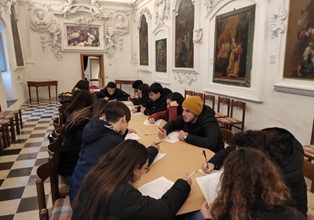
The Chapter House: the cathedral’s art gallery.
The hall of the Congregation of the Immaculate Conception, which the faithful traditionally refer to as the ‘chapter house’, is the place where the canons would gather ‘in chapter’ for prayer and the communal reading of biblical passages or chapters from their rule. Although the canons lived a monastic lifestyle, they did not belong to any monastic order but were directly under the authority of the Bishop. The vault of the Chapter House features a fresco depicting the Immaculate Conception, and there is also a small apse containing a shield bearing the symbol of St Peter, supported by cherubs dating from the mid-18th century. More difficult to date is the ancient, now-dry fountain, still visible on the wall to the left as you enter, bearing the image of two eight-pointed Maltese crosses; this probably refers to the widespread presence of the Knights of St John of Jerusalem, who also founded an important hospital complex in Modica, complete with an adjoining church dedicated to St John the Baptist (now the municipal auditorium). Since Easter 2024, the Chapter House has served as the cathedral’s art gallery and a temporary home for canvases and paintings from churches that are currently closed or undergoing restoration. The large canvas at the back was discovered by chance in January 2023. Following reorganisation work in the sacristy, a rolled-up canvas was found in a space between the wall and the rear of the altar of St Peter and the Paralico; it was initially mistaken for a carpet. There was great wonder and amazement when it was unrolled, revealing the key depiction of the Martyrdom of the Holy Apostle. Thanks to funding from the Sicilian Regional Government, the painting was fitted with a stretcher frame and fully restored. Its permanent placement in the Chapter House rather than in the church – where it had likely been since the 17th century – reflects a desire to highlight the fragility of cultural heritage and the need for constant attention and care. The canvases and paintings on either side of the Chapter House come from the Church of Our Lady of Perpetual Help, which was closed in the 1970s due to structural problems. The paintings were left in the church in a state of total neglect. Following authorisation from the relevant authorities, the canvases were transported to the mother church and partially restored. Today they are once again on display and await their return to the church once safety works on the Church of the Perpetual Help have been completed.
Description of the paintings. Click on the title to continue reading.
1. The Triumph of Saint Ignatius
Father Giuseppe Mauro, 1734, oil on canvas.

The painting, situated on the church’s central altar, is signed and dated in the bottom right-hand corner. The artist is Giuseppe Mauro, and the date of creation is 1734. The painting was produced during the final phase of the church’s post-earthquake restoration, carried out according to a design attributed to Rosario Gagliardi.
The painting is fully in keeping with Jesuit ideology, which sought to spread the Catholic faith through universal mission. At its centre, in an elevated position, is the order’s founding saint, St Ignatius, suspended on a cloud casting its shadow downwards. Ignatius is enveloped in a golden halo; with his right hand he displays the Order’s emblem, a radiating disc bearing (the anagram of) Christ’s monogram, and with his left hand he holds a book bearing the inscription: Ad maiorem Dei gloriam. On the left, an angel holds a scroll that fully articulates the Order’s missionary vocation and explains the very meaning of the painting: *Coelo affixus sed terris omnibus sparsus* (attached to heaven but spread throughout all the lands).
In the lower register, surrounding a globe resting on a pedestal, are the personifications of the continents known at the time: Europe and Asia, in the foreground on the left and right respectively, whilst Africa and America are in the background and in semi-darkness. Europe’s primary role is emphasised by the crown and sceptre, which establish her as the world’s leader. At her feet, the papal tiara—centred and dominant in relation to the Habsburg and French crowns—affirms the supremacy of the Catholic Church over temporal power. At her feet, two cornucopias, overflowing with fruit and jewellery, indicate the wealth of the two continents. Africa and America, like the other two continents, display the typical attributes described in Ripa’s *Iconologia*. In the figure representing Africa, nudity signifies a scarcity of raw materials, whilst the elephant tusk represents the quintessential African animal. The figure representing America is also nude, with a meaning analogous to that of Africa, and is dressed in traditional attire, complete with bow and arrow. The painting presents, in a reduced and simplified form, themes developed by the Jesuit Order in Rome at the mother church, where a celebratory and Eurocentric tone prevails.
*Ignatius was born in Loyola, Spain, in 1491; in 1534 he founded the Society of Jesus with a missionary purpose and a commitment to total obedience to the Pope. He died in Rome in 1556 and was canonised by Pope Gregory XV in 1622.
2. St Francis Xavier baptising Asians
Anonymous, 18th century, oil on canvas.
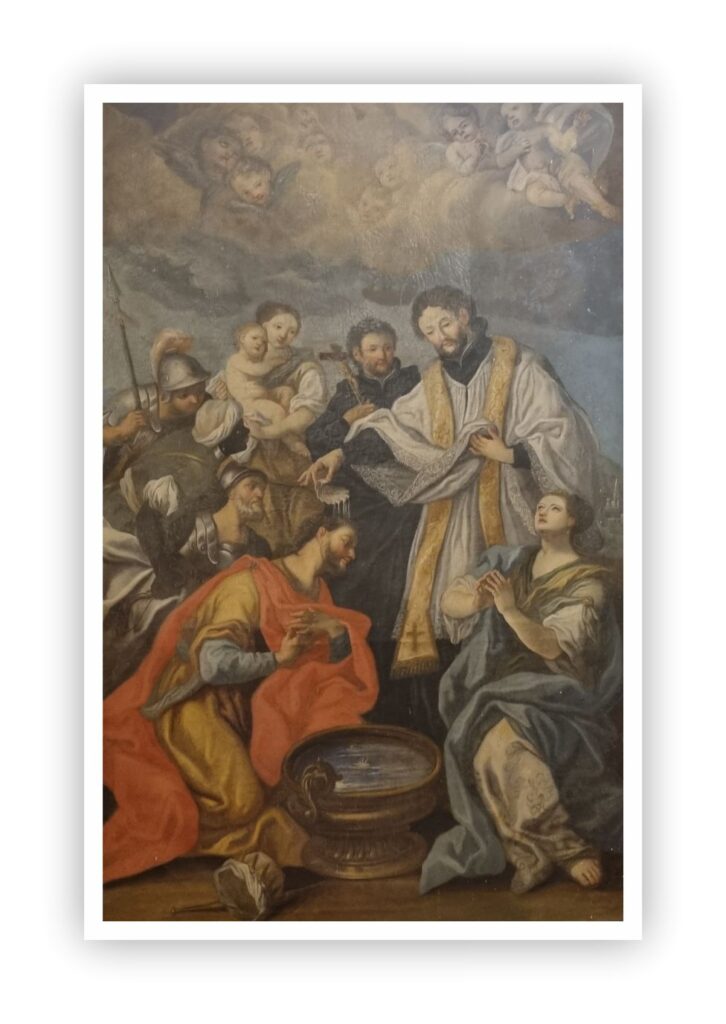
The painting, situated in the right-hand arm of the transept of the Church of the Soccorso, is unsigned but is similar in its formal composition and the brilliance of its colours to *The Triumph of St Ignatius*; for this reason, it has been attributed by Giorgio Flaccavento to Giuseppe Mauro. Both works reflect the chromatic style of Solimena, a Neapolitan painter whose compositional techniques became widespread in southern Italy during the 18th century. St Francis Xavier, a friend of St Ignatius, was the first to spread Christianity throughout Asia, reaching as far as China and Japan. He is depicted in the top right-hand corner, alongside a fellow friar holding a cross, whilst baptising a man and a woman in elegant robes. On the ground, near the baptismal font, a crown suggests that those being baptised may be figures of high rank. The isolated figures, rendered in vivid colours and with sculptural forms, are depicted through bold drapery. The elegant robes of the figures, rendered with an eye for detail in certain specific elements such as St Francis Xavier’s stole or the arabesques on the woman in the foreground, echo the elegance of the European and Asian garments in the Triumph of St Ignatius.
Born in 1506 into the noble Basque Xavier family in Navarre, Francis moved to Paris in 1525 to continue his studies, becoming a magister artium. In Paris, he found himself alongside Ignatius of Loyola, his fellow student and flatmate. For a long time he resisted the powerful attraction that Ignatius and his vocation held for him, until in 1534, on the Feast of the Assumption, he too found himself among the first Jesuits at Montmartre, consecrating himself to God for ever.
Having set out for Palestine, he was forced to stop in Venice, as the Holy Land was inaccessible due to the Muslim Turks; there, ordained a priest at the age of 31, he devoted himself, alongside Ignatius, to drafting the Constitutions of the Society of Jesus. He then travelled to Rome with his companions. Francis, having been appointed Apostolic Nuncio by the Pope, set off for the Far East. In 1542, he first landed in Mozambique and then reached Goa, the capital of the Indies, where he began his mission of evangelisation. He then brought the Gospel to Sri Lanka, to Malacca – where he met the first Japanese – and to the Moluccas. Driven by ardent missionary zeal, he reached southern Japan in 1548. He travelled as far as China, where he died in Sangchuan on the night between 2 and 3 December 1552. He was canonised in 1622 by Pope Gregory XV.
3. Saint Aloysius Gonzaga
Anonymous, 18th century, oil on canvas.
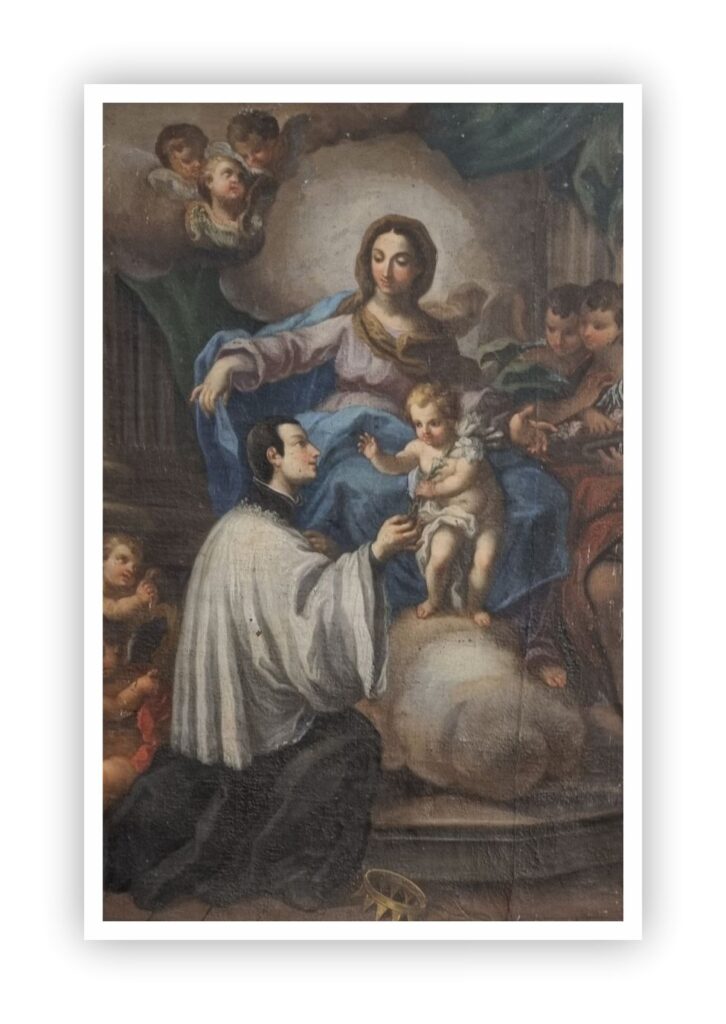
The painting, located in the left aisle of the Church of the Soccorso, bears neither a date nor a signature. It may have been painted in the second half of the 18th century, given the prevalence of darker tones compared to Mauro’s works.
It depicts Aloysius in accordance with the recurring iconography that shows him as a young, handsome man, pale-skinned with dark hair, wearing the typical Jesuit habit and a white, lace-trimmed surplice. The saint is kneeling, shown in profile, and is receiving a lily from an angel – his attribute linked to the vow of chastity he made at the age of twelve. In the centre, the Virgin Mary casts a gentle, protective gaze towards him, her billowing mantle spreading out to almost cover his head. The predominantly sombre tones of the background are counterbalanced by the foreground, where the pastel shades of Mary’s robe and mantle alternate with the whiteness of the saint’s tunic, which illuminates the scene. The crown on the ground, in the foreground, may allude to Luigi’s renunciation of his rights as heir apparent to the Gonzaga marquisate in favour of his brother.
4. The Crucifixion of Saint Peter the Apostle
Anonymous, 17th century, oil on canvas.
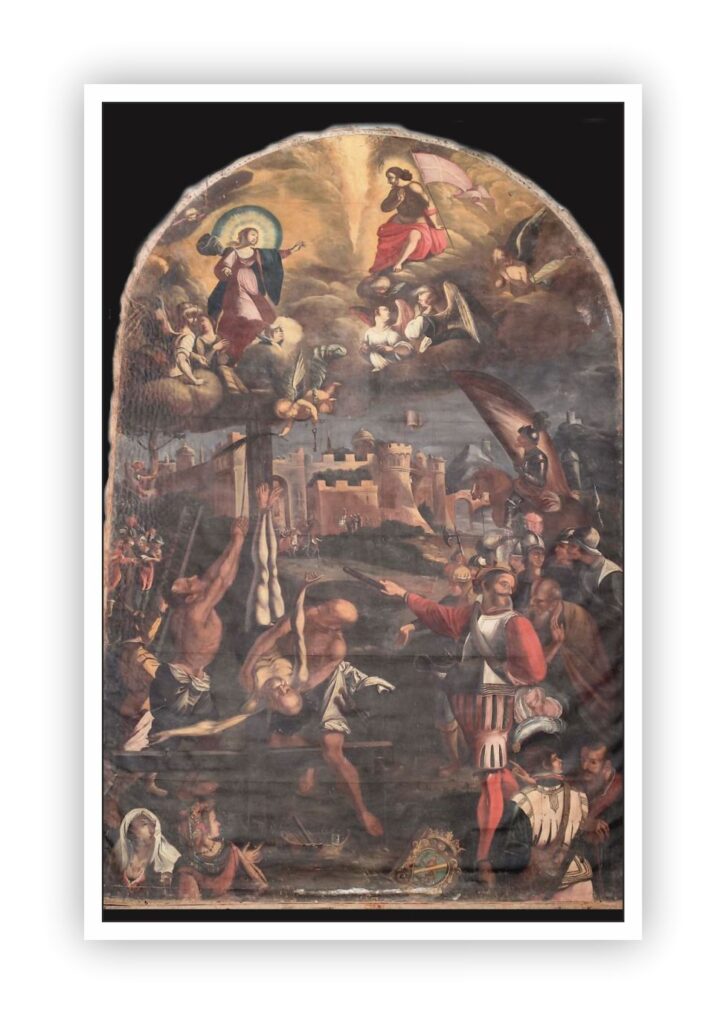
The painting is an oil on canvas depicting the Crucifixion or Martyrdom of Saint Peter; it measures 3.30 × 5.10 metres and was discovered quite by chance in January 2023 when, at , following a general tidying-up of the sacristies, behind the altar dedicated to Saint Peter and the Paralytic, the rolled-up canvas was found in a sort of cavity. There was no record whatsoever of the painting.
The arched shape and dimensions of the canvas correspond to those of the church’s side altars, so the painting may have been placed in the area where it was recovered, in what is now the sacristy but was a private chapel in the 17th century. Documentary sources, including Bishop Fortezza’s visit to Modica in 1683 and a report following the 1693 earthquake, dated 1697, explicitly mention a chapel dedicated to the crucifixion and martyrdom of Saint Peter. It is therefore likely that the painting already existed in the 17th century.
It is currently not possible to make out either a date or a signature on the painting. The iconography of the canvas, in its main scene, refers to a work by Guido Reni, *The Crucifixion of Saint Peter* (1604–5), whose compositional structure it unambiguously echoes. Reni’s work was commissioned for the church of San Paolo alle Tre Fontane and is now housed in the Vatican Pinacoteca in Rome. The theme of the Crucifixion is a key episode in the life of the apostle and has been depicted by great masters such as Michelangelo in the Pauline Chapel at St Peter’s and Caravaggio in Santa Maria del Popolo.
In Modica’s painting, the scene is enriched by the presence of a group of soldiers to the right and left of the central figure and his tormentors. Among the soldiers, one stands out in the foreground, dressed in Spanish-style robes and holding a sort of sceptre of command with which he orders the execution.
At the centre of the canvas, a landscape background alludes to the fortified walls of ancient Rome; at the top, a little angel presents the saint with the palm of victory and the keys. Higher up, the Virgin Mary and Christ are separated by a golden slit, alluding to the glory to which the saint is destined.
In the foreground, cut in half, are figures and a man looking out of the painting; they may not belong to the characters of the sacred narrative but to the real world. They are in all likelihood the patrons and the painter. Overall, it is a complex scene in which the martyrdom of Peter is counterbalanced by that of the soldiers, who are equally relevant and significant. The city walls are given greater prominence thanks to the empty space that makes them stand out from the background. Finally, the scene at the top seems to emphasise the divine dimension. It is a picture within a picture, the meanings of which are yet to be interpreted.
An important clue is the presence, in the lower foreground, of the coat of arms of the Lorefice family, who were prominent in the 17th century as generous benefactors of the church of San Pietro.
A recent comparative study has suggested that the painter was Giuseppe Reati of Syracuse, who worked in Mario Minniti’s workshop. This attribution is based on a stylistic and visual comparison with a work by Reati housed in the Church of Santa Lucia alla Badia. As well as the details, the striking similarity of the artist’s self-portrait is evident in both the Modica and Syracuse paintings.
5. Adoration of the Magi
Domenico La Bruna, 1739, oil on canvas
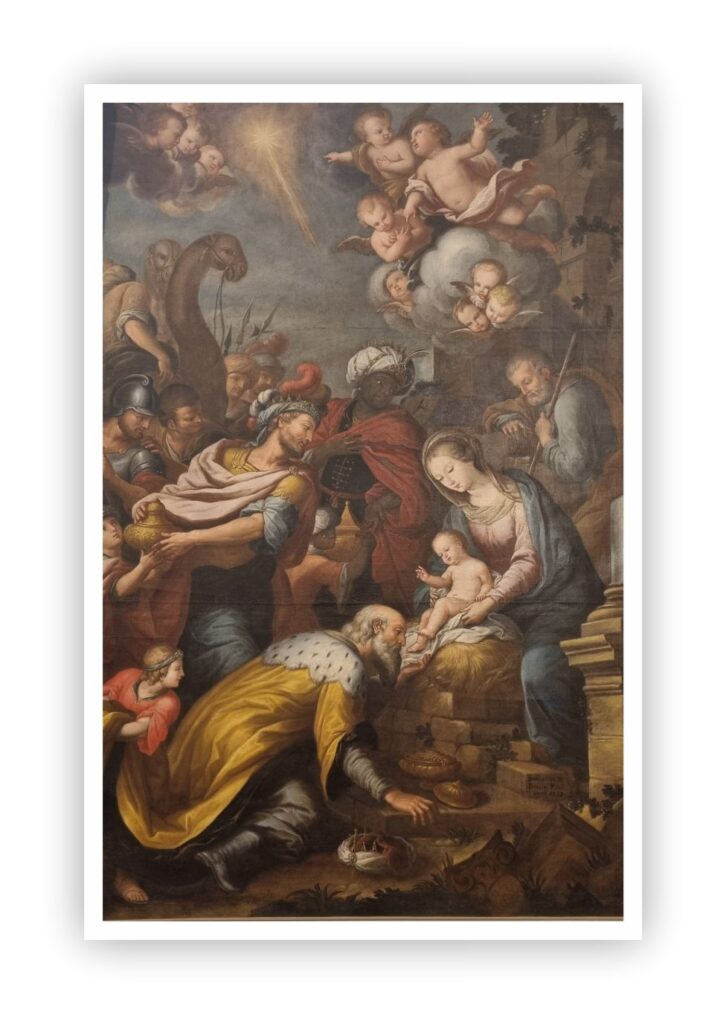
Among the paintings recovered in the final days of 2022 from the Church of the Soccorso, by order of the Ragusa Superintendency for Cultural and Environmental Heritage, the Adoration of the Magi, painted by Domenico La Bruna in 1739, stands out for its importance and the quality of the work. Until recently, various artists and dates of creation had been suggested for this work.
After the paintings were transported from the Church of the Soccorso to the Church of St Peter the Apostle, an initial cleaning revealed the signature and date in the bottom right-hand corner. Given its significance, restoration work was carried out immediately.
Originally from the western part of Sicily, specifically Trapani, Domenico La Bruna was determined to pursue his passion for painting. He was ordained a priest in 1720, and his works were commissioned by various religious orders. He is regarded as one of the most important artists of 18th-century Sicilian art, with his works showing the influence of artists such as Maratta, Cuca Giordano, Olivio Sozzi and Vito d’Anna.
He was commissioned in Modica to create paintings for the Church of the Holy Names of Jesus and Mary, belonging to the Jesuit Order and now known as Santa Maria del Soccorso, for which he produced only this single canvas.
In the painting *The Adoration of the Magi*, one can admire the quality of the facial expressions, the light streaming down from above and falling upon the faces of the figures, and the curious depiction of the camels, which the artist had probably never seen in person. The Three Kings represent the different continents; thus, the eldest represents Europe, which offers gold. The African continent is represented by one of the Three Kings, who is of colour and, according to tradition, offers myrrh. It can therefore be inferred that the figure on the left represents Asia, which, according to tradition, brings frankincense. The painting was highly acclaimed, and several religious orders in Modica commissioned works inspired by La Bruna’s painting. No other paintings by this artist are found in our area. However, several of La Bruna’s works, also of a religious nature, are located in the provinces of Trapani and Palermo, as his principal patrons included the Jesuit fathers working in western Sicily.
6. The Descent from the Cross
Anonymous, 19th century, oil on canvas.
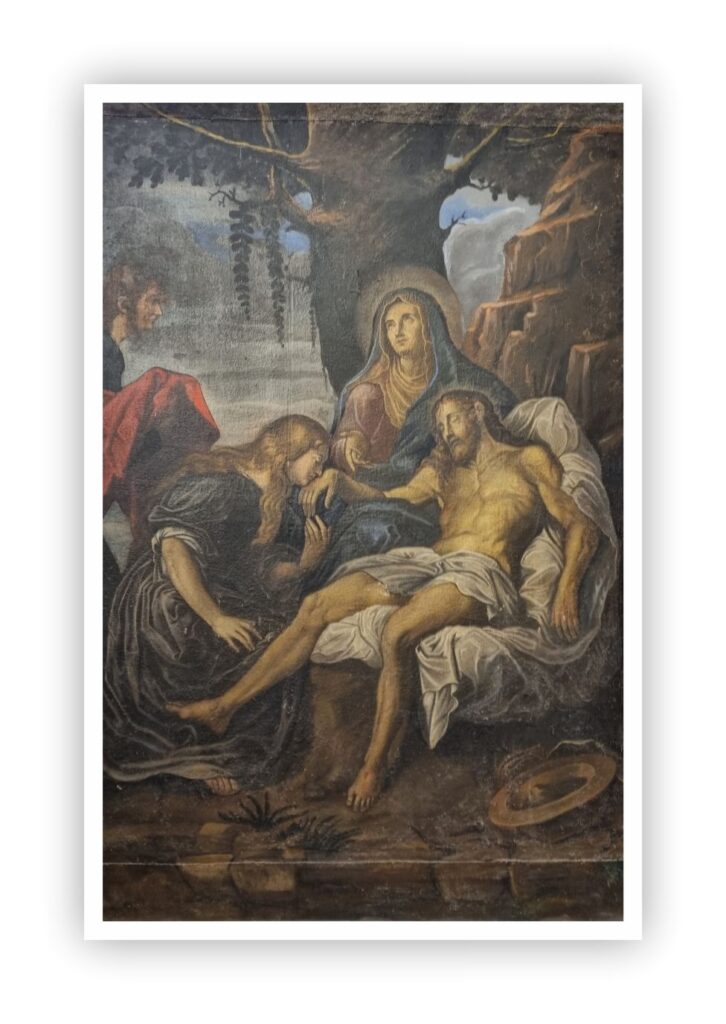
The painting, located in the right-hand aisle of the Church of the Soccorso, bears neither a date nor a signature. Jesus, taken down from the cross, lies on a burial shroud and is supported by Mary, whilst Mary Magdalene, kneeling, pays her respects to him. On the left, John enters the scene carrying a red cloth. The background consists of a large tree in the centre and a rocky outcrop on the right. In the foreground, the instruments of the Passion and the basin for anointing remind us of the sacrifice of Christ on the Cross. Brown tones predominate; the postures are rigid and the faces solemn. The painting may date from the 19th century.
In the Gospel according to Mark, the episode took place in the evening, on Parascève (‘Preparation’, the eve of the Sabbath); Joseph of Arimathea, said to have been a prominent member of the Sanhedrin and one who awaited the kingdom of God, went to Pilate to ask for Jesus’ body. Pilate, surprised that Jesus was already dead, sought confirmation of his death from a centurion and only then granted the body to Joseph. Joseph, having purchased a linen cloth, took the body down from the cross and wrapped it in the cloth, then placed it in a tomb hewn out of the rock, which he sealed by rolling a stone in front of it. Mary Magdalene and Mary ‘the wife of Joses’ stood watching where the body was laid.
In the Gospel according to Matthew, on the evening following Jesus’ crucifixion, the wealthy Joseph of Arimathea, who had become a disciple of Jesus, asked Pilate for the body, and Pilate handed it over to him. Joseph wrapped the body in a white linen cloth, laid it in his new tomb—which he had had hewn out of the rock—and sealed it by rolling a large stone in front of the entrance, then went away. Mary Magdalene and ‘the other Mary’ were present at the entombment.
The Gospel according to Luke presents Joseph of Arimathea as a member of the Sanhedrin and as a good and righteous man who ‘was awaiting the kingdom of God’; this Gospel specifies that Joseph had not agreed with the decision of his colleagues. Joseph took Jesus’ body down from the cross, wrapped it in a linen cloth and placed it in a tomb hewn out of the rock, ‘in which no one had yet been laid’; the evangelist notes at this point that it was the day of Parascève and that the lights of the Sabbath were already shining. Watching over the tomb and the laying of the body within it were ‘the women who had come with Jesus from Galilee’; they returned to prepare the spices and ointments for the body, but observed the Sabbath rest.
In contrast, the Gospel according to John recounts that Joseph of Arimathea was a disciple of Jesus, but that he kept this fact hidden for fear of the Jews. Joseph asked Pilate for Jesus’ body, and Pilate granted it to him. Joseph went to the place of execution with Nicodemus, who was carrying myrrh and aloes; the two took the body down from the cross and wrapped it in linen cloths and aromatic oils. At the place of execution there was a garden containing a tomb that had never been used; they laid Jesus there, as it was the eve of the Sabbath and the tomb was the nearest one.
7. Statue of St Louis Gonzaga
Saint Aloysius Gonzaga (1568–1591) was an Italian member of the Society of Jesus, venerated as a saint by the Catholic Church and universally recognised as the patron saint of young people. Born into one of the most powerful noble families of the Renaissance, he was the eldest son of the Marquis of Castiglione delle Stiviere and was brought up from childhood in the military life and the splendour of the courts of Mantua, Florence and Madrid. Despite strong pressure from his father, who wished for him to pursue a brilliant political career and succeed to the noble title, Luigi showed a profound spiritual calling from an early age, eventually renouncing his dynastic rights in favour of his younger brother. Having entered the Jesuit novitiate in Rome under the spiritual guidance of Robert Bellarmine, he distinguished himself through the austerity of his asceticism, his dedication to study and a purity of conduct that became legendary. His brief earthly life came to an end at the age of just twenty-three, after contracting the plague in Rome whilst devoting himself body and soul to caring for the sick during the severe epidemic that was ravaging the city. Canonised in 1726 by Pope Benedict XIII, he remains to this day a shining symbol of total self-sacrifice, purity of spirit and selfless service to the least among us.
Back to